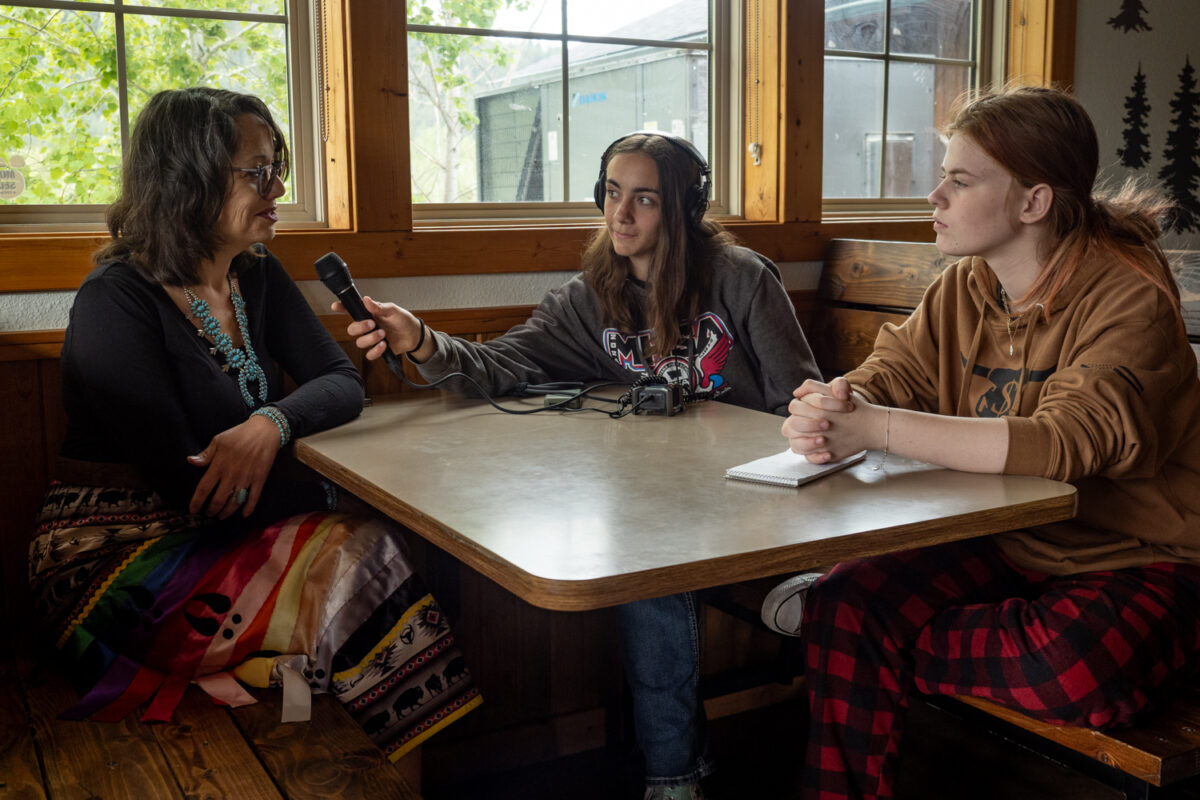
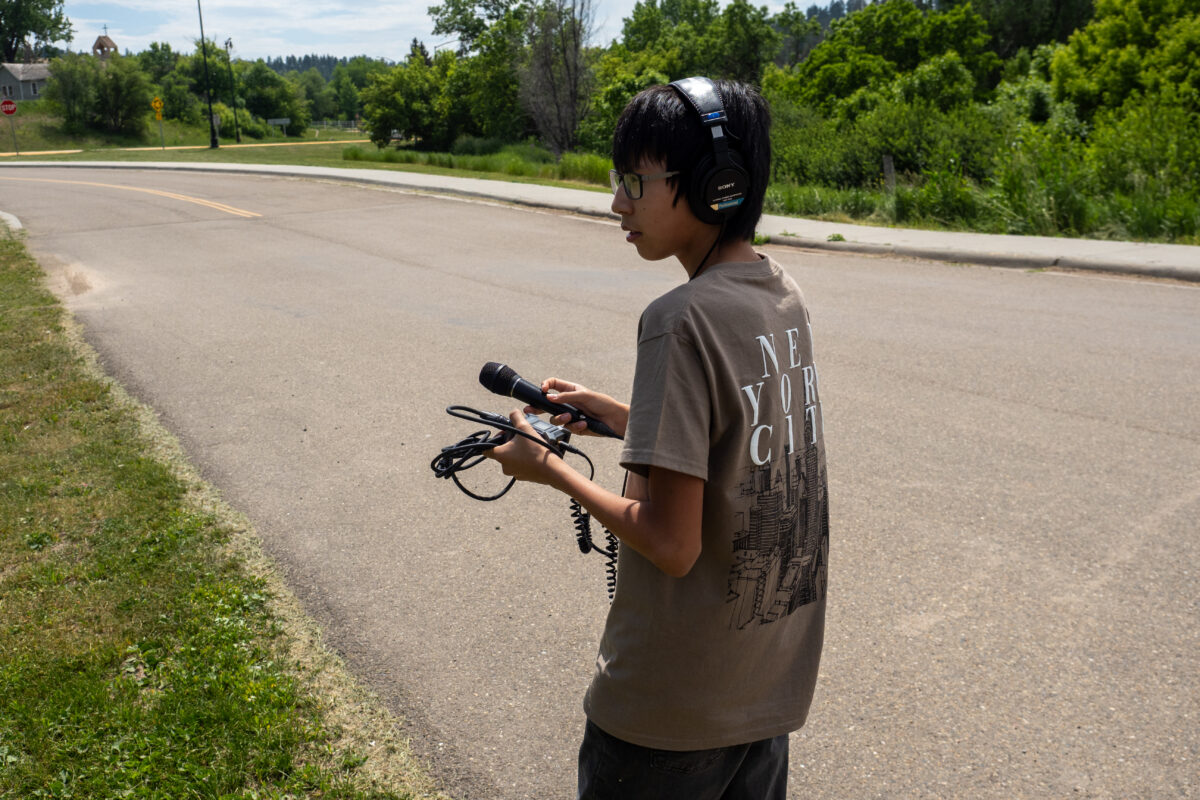
This audio story was narrated by journalism apprentices Macey Hogan and Sly Popetsaitke.
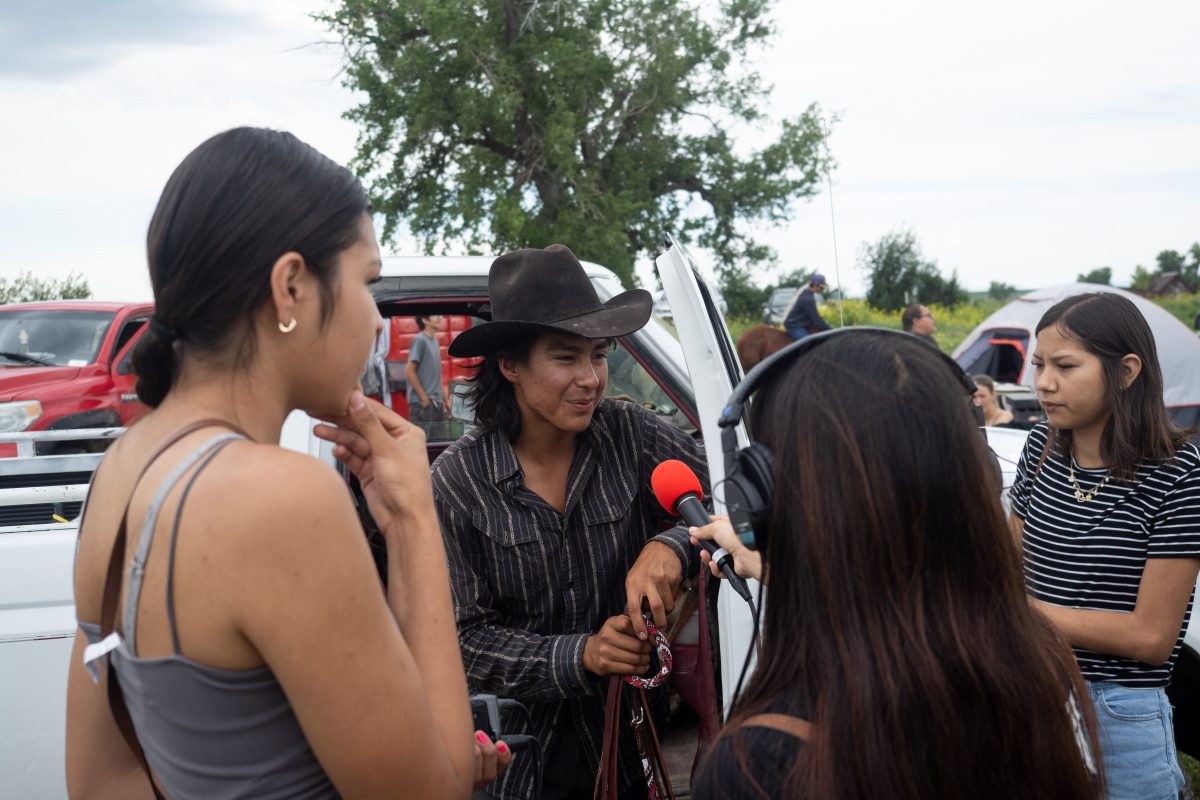
On the weekend of June 25, thousands of descendants, visitors, and representatives from 19 Native Nations gathered on the Crow Reservation near Crow Agency, Montana, to commemorate the 150th anniversary of the Battle of Greasy Grass, also known as the Battle of the Little Bighorn. The anniversary brought together reenactors, historians, community members, and visitors from across the world to reflect on the battle’s enduring legacy.
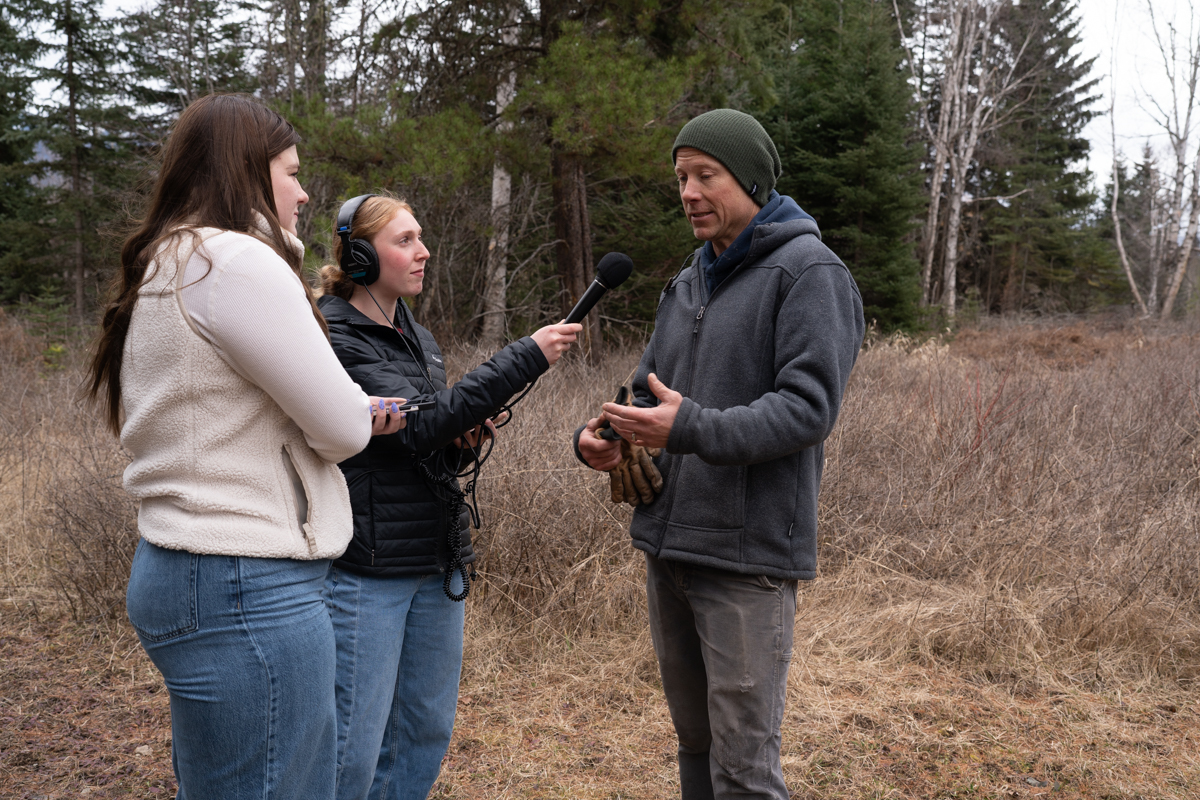
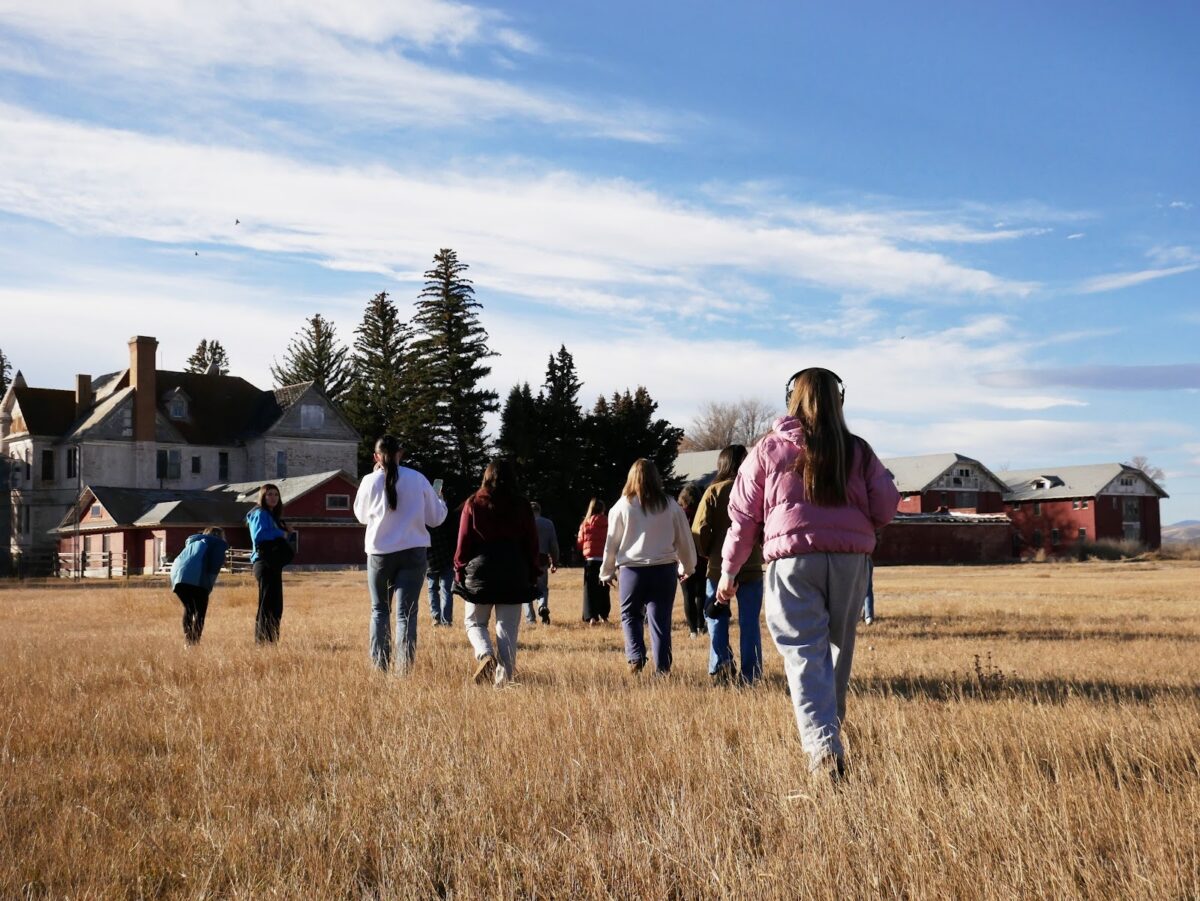
During the event, a group of teen journalism apprentices from Crow Agency spent five days researching and practicing the fundamentals of audio journalism in order to cover the annual Battle of the Little Bighorn reenactment hosted by the Real Bird family. Working together, they interviewed reenactors, organizers, audience members, and their community members to understand why people attended and what the 150th anniversary meant to them. Multiple interviewees said the battle continues to be a defining moment in American and Indigenous history, and still shapes conversations about Tribal sovereignty, resilience, and remembrance.
Using interviews and natural sounds of the reenactment, the students produced a vox pop, which is an audio story that weaves together many voices to capture the experiences, reflections, and perspectives of those around them.
Along the way, these young journalists gained hands-on experience through field reporting, using audio equipment, script writing, and digital editing. More importantly, they helped to preserve voices and document history through the people who lived it, inherited it, and continue to carry its meaning forward. Listen to audio story they produced above!
The story was reported by Montana Media Lab journalism apprentices Benjimin Bigman III, Zeeka Birdinground, Lawrence Brown, Erinniah Dawes, Nathaniel Deputy, Calynn Falls Down, Claycee Fitzpatrick, Solomon Garcia, Caidence Gone, Macey Hogan, Christian House, Hyram Morning, Sly Popetsaitke, Karaya Takes Enemy, Kessley Takes Enemy, Leroy Takes Horse Jr., Maliyah Walks, and RaMyra White in partnership with Little Big Horn College.
Elections for Blackfeet Tribal Business Council will be held June 30, 2026. Local teens interviewed candidates for BTBC to create a resource for voters at the first Montana Media Lab Journalism Apprenticeship at Blackfeet Community College in Browning.
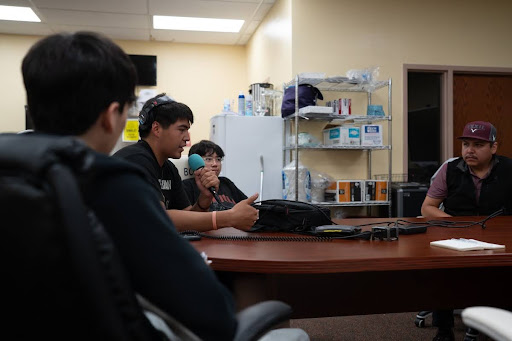
Apprentices attended a one-week program, run by the Montana Media Lab at the University of Montana School of Journalism. Participants gained job experience, career skills and produced important reporting for their community.
Each of the ten BTBC candidates was invited for an interview at Blackfeet Community College in early June. Apprentices worked together to choose five questions to ask every candidate. Apprentices also asked candidate-specific questions that informed their introductions of each candidate.
Listen to the candidates’ answers below.
Browning District #2
Jaime Bechel
How have you been involved with the community? How will that experience guide you as a tribal council member?
How would you work with federal, state and local governments to benefit the Blackfeet Tribe?
What is your opinion on blood quantum and future tribal descendants?
How will you manage our tribal finances?
How do you plan to address mental health for youth and the general population?
TJ LaFromboise
How have you been involved with the community? How will that experience guide you as a tribal council member?
How would you work with federal, state and local governments to benefit the Blackfeet Tribe?
What is your opinion on blood quantum and future tribal descendants?
How will you manage our tribal finances?
How do you plan to address mental health for youth and the general population?
Browning District #3
Mary Reevis
How have you been involved with the community? How will that experience guide you as a tribal council member?
How would you work with federal, state and local governments to benefit the Blackfeet Tribe?
What is your opinion on blood quantum and future tribal descendants?
How will you manage our tribal finances?
How do you plan to address mental health for youth and the general population?
RJ Goss
How have you been involved with the community? How will that experience guide you as a tribal council member?
How would you work with federal, state and local governments to benefit the Blackfeet Tribe?
What is your opinion on blood quantum and future tribal descendants?
How will you manage our tribal finances?
How do you plan to address mental health for youth and the general population?
Heart Butte District #4
Patrick Armstrong Jr.
**Patrick was not able to make it to the interview due to a conflict in his schedule. Apprentices used his online communications to put together the introduction above.
Terry Tatsey
How have you been involved with the community? How will that experience guide you as a tribal council member?
How would you work with federal, state and local governments to benefit the Blackfeet Tribe?
What is your opinion on blood quantum and future tribal descendants?
How will you manage our tribal finances?
How do you plan to address mental health for youth and the general population?
Seville District #6
Susan Reevis Webber
How have you been involved with the community? How will that experience guide you as a tribal council member?
How would you work with federal, state and local governments to benefit the Blackfeet Tribe?
What is your opinion on blood quantum and future tribal descendants?
How will you manage our tribal finances?
How do you plan to address mental health for youth and the general population?
Everett Armstrong
How have you been involved with the community? How will that experience guide you as a tribal council member?
How would you work with federal, state and local governments to benefit the Blackfeet Tribe?
What is your opinion on blood quantum and future tribal descendants?
How will you manage our tribal finances?
How do you plan to address mental health for youth and the general population?
Old Agency #8
Iliff Scott Kipp Sr.
How have you been involved with the community? How will that experience guide you as a tribal council member?
How would you work with federal, state and local governments to benefit the Blackfeet Tribe?
What is your opinion on blood quantum and future tribal descendants?
How will you manage our tribal finances?
How do you plan to address mental health for youth and the general population?
Tony Sinclair
How have you been involved with the community? How will that experience guide you as a tribal council member?
How would you work with federal, state and local governments to benefit the Blackfeet Tribe?
What is your opinion on blood quantum and future tribal descendants?
How will you manage our tribal finances?
How do you plan to address mental health for youth and the general population?
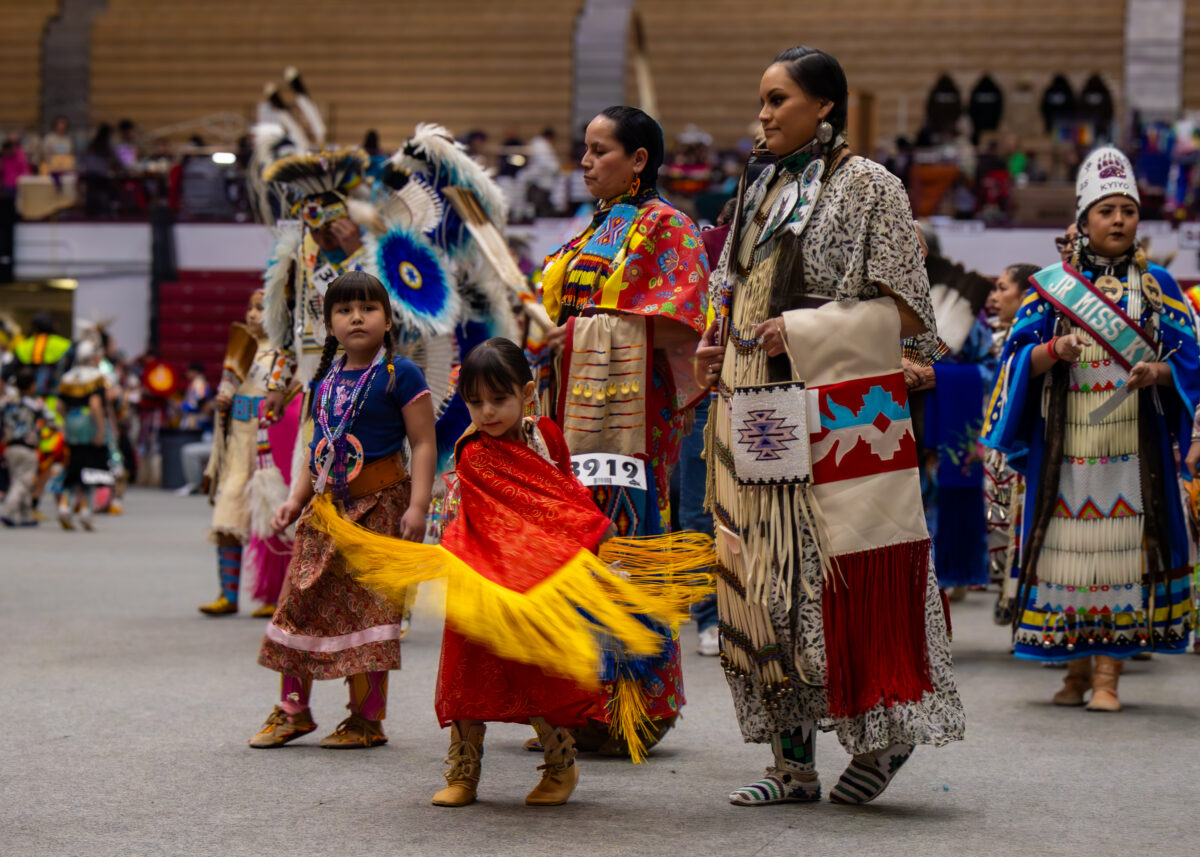
Dancing to the heartbeat of the drums, a young girl brightens the arbor with her fiery regalia at the 57th Annual Kyiyo Powwow, held on April 17th at the University of Montana campus. Surrounded by her family, she proudly shows off her skills as she participates in the Tiny Tots Fancy Dance. Photo and caption by Alexia Wilson, Polson High School.
During the Montana Media Lab’s annual High School Reporting Workshop at the UM School of Journalism, students from Polson and Browning worked alongside the Montana Media Lab and guest journalist instructors to hone their audio, print, and photojournalism skills.
They worked with reporters from Montana Public Radio, KPAX News, and the freelance photojournalism world. Students practiced their reporting in the field, conducting interviews and taking photos around campus. The workshop culminated as the students reported on the 57th Kyiyo Pow Wow.
They pitched story angles and prepared interview questions, hoping to learn more about the arts and crafts vended at the Powwow, the stories behind specific dances and songs, and what the Powwow meant to attendees. The students gathered their best photos, recordings, and quotes, and have now been published in Char-Koosta News, the official publication of the Flathead Indian Reservation. Check out some of the student photos, audio, and written work below!
People gather together to watch the drum group Night Hawk Jrz playing their personal song. Photo by Kinzee TakesHorse, Polson High School.Bill Breen sells his skirts, prints, stickers, and more at Powwows across the country. Photo by Izabella Spotted Eagle.
Students Ekko Underbear, Hunter Wippert, and Galen Berg reported this audio story, “Stories of the Drums,” profiling a drummer, dancer, and Kyiyo student organizer:
Polson students wrote these articles for Char-Koosta News:
Generational Celebration
By Raya Lucas, Polson High School
The annual Kyiyo Powwow for many is the first celebration they attend heading into summer. This year from April 17-19 was the 57th Kyiyo Powwow organized by the Kyiyo Native American Student Association at the University of Montana Adams center in honor of “Missing and Murdered Indigenous Women and People (MMIWP).” A Red Regalia Special was put on to remember Jadie Butterfly and others lost due to MMIP. The Kyiyo Powwow aims to unite Native Americans from all over the nation and to showcase the diversity of each tribe in order to safeguard important culture and tradition. When you first enter the atmosphere of the powwow you can hear and feel the beat of the drum, the jingles on regalia, and see the numerous young people and elderly people proudly representing their heritage. Some wore outfits and jewelery with designs and colors specific to the tribe they’re affiliated with, while everyone was enriched in the dance and music.
Powwow attendee Jill Graves is an enrolled member of the Shoshone Bannock tribe out of Fort Hall Idaho, who has been to the Kyiyo Powwow well over 15 times. To her, powwows are a way of bringing tribes together and a way to meet new people. Graves describes Kyiyo as a fun event. She said, “Living in a big city (Missoula) that is basically non-native, it’s cool to share what our traditions are with them (non-native population).” Her favorite event is “Tiny Tots,” which features young dancers in traditional dance. Graves’ late mother taught her how to do beadwork, so when she had her own son she wanted to show him what his grandma had taught her. She believes it’s important to have pride in your culture and to share that with the younger generations. A common misconception, she shared, about powwows is that non-native people expect the stuff that’s in books or history, but rather powwows show the actual traditions and culture that unites tribes.
According to one of the original organizers of the Kyiyo Powwow, Steve Snell, a powwow is a matter of bonding that comes from tribal identity and tradition, emphasizing the importance of younger generations inheriting these customs. He says, “There’s more to a powwow than meets the eye. It gives the outside community the idea that we are people that enjoy living.” He thinks that there is an educational value that the broader community can gain by attending not just Kyiyo but other powwows as well. Grave adds to this by commenting, “For non-natives that think they’re not welcome here (powwows), everybody’s welcome. Nobody is going to judge you because you’re trying to learn what us Native Americans do to celebrate our culture.”
Luke Kwnen participated in the 55+ dancing events. He has been dancing in Powwows since he was twelve years old. Photo by Juliet Boen, Polson High School.Photo by Dejanae Prettyboy, Browning High School.
The Dance that Heals
By Griffey Whisman, Polson High School
Students of University of Montana held Kyiyo Powwow in Missoula during April 17th to 18th, showcasing songs that have been passed down through families and tribes for generations. One of the most important parts of a powwow is the dancers that help tell the story of the people through dance. The 57th annual Kyiyo Powwow has been a hotspot full of different families and tribes throughout the years and people go for a variety of different reasons. Some people reported they go to connect with their heritage while others hope to find old friends and make new ones. The president who was in charge of the event, Lailia TakesEnemy, and other students in the Kyiyo group at the University of Montana had put together a culture gathering that young and old people could enjoy together. Powwows mean different things to different people, but one the most central parts of a powwow is the music.
Music has been either passed down tribally or by family so the songs performed at powwows are either family songs or songs that a whole tribe share. The music is made up of three crucial parts, the drums which is the heartbeat of the song, the vocals which tell the story and the dancers who have many different significant parts of the music. First, the regalia of the dancers are very important. Long time powwow enjoyer Jason TurningRobe explains, “Each outfit means different things. My daughter’s a jingle dress dancer, that’s a traditional medicine dress. Dancers like the men show warriors and the women are more elegant. Then there’s the fancy that came later. That’s more of an entertainment.” Another thing that dancers contribute to the music is song. Many dancers wear regalia, or outfits for dancers, that have bells or other bits that produce a jingle every time the dancer moves with the drums. There are many different types of dancers for example jingle and grass dancers are meant to be healing dances, healing the earth and the dancers involved. Other dances, such as chicken dance, mating dance and fancy dancers, are meant to preserve culture and religion. There is also sometimes a competition for dancers, Kyiyo powwow held one this year along with many years before. Every dance helps tell the story of the music.
Each dance takes time to learn, and each dance requires practice and lots of foot work memorization to perform in it. Most of the time, head dancers lead the dance, at the Kyiyo Powwow, Neveah KillSight was the head women dancer while Cactus RunsAbove was the head for males. People want to dance for many reasons, but long-time dancer Makenna Aimsback describes her experience as, “When you dance with it, it’s like something connects with you while you’re dancing. It’s everything, your worries go away and you just enjoy the moment out there while you’re dancing. It’s pretty fantastic.” The dancers are important to powwows and the Kyiyo Powwow was no different, several hundred dancers performed over the two-day event. Even younger people who went, such as six-year-old Kayson who want to be a dancer when he grows up. The Kyiyo powwow has been important for many families for years, and the dancers that performed are more than fun visuals, they symbolize tradition, heritage and much more.
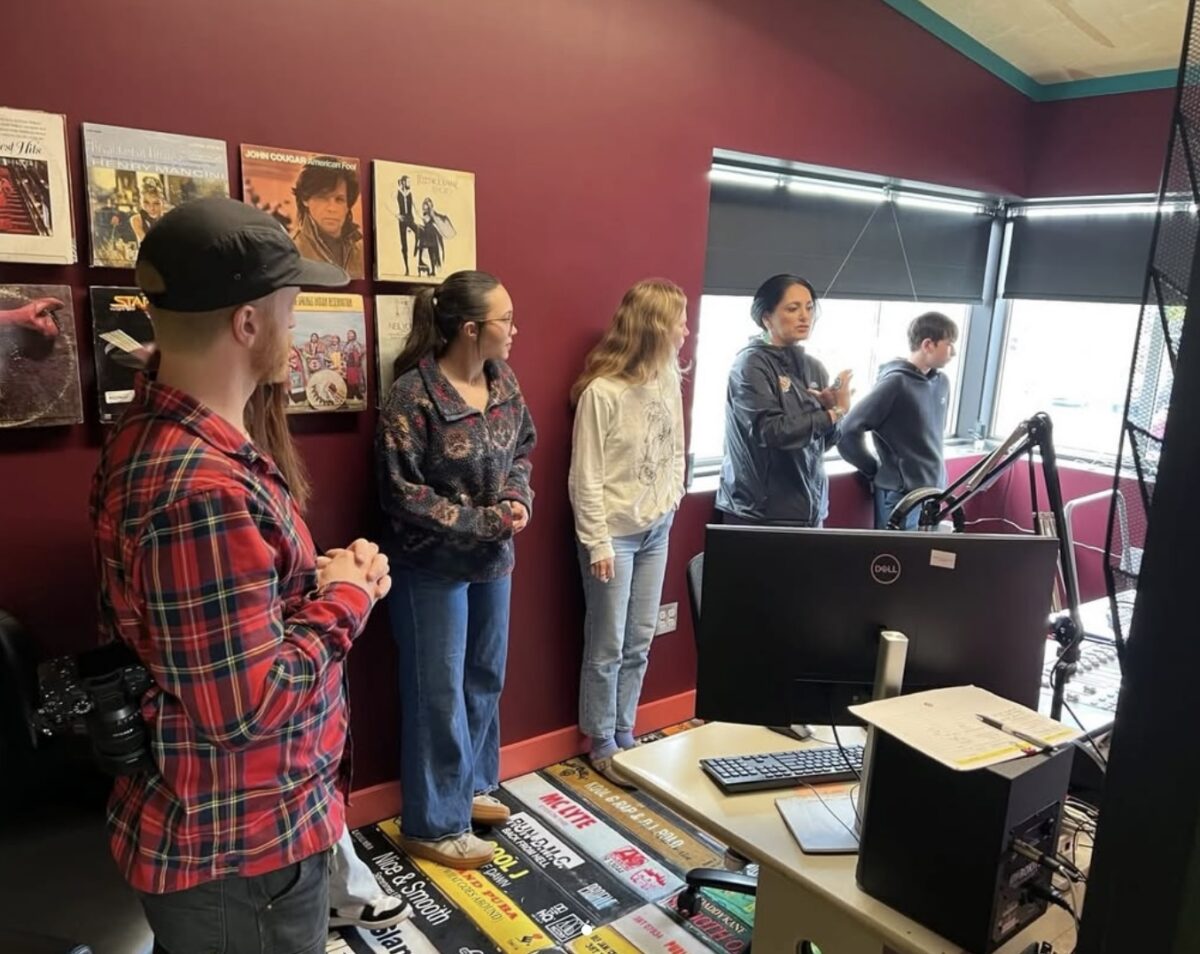
Students and Montana Media Lab staff get an intro to KCUW, Umatilla Reservation Community Radio in Pendleton, Oregon. Photo by Sammantha McCloud.
On the Umatilla Indian Reservation in Oregon, an annual basketball tournament draws spectators and youth athletes from all across the Northwest. But to many on the reservation and beyond, the impact of this tournament is bigger than basketball.
Basketball Against Alcohol and Drugs, or BAAD, was first organized by the Confederated Tribes of the Umatilla Indian Reservation over thirty years ago to pair the community’s love of basketball with education on drug and alcohol abuse. Students from Pendleton, Oregon went to the BAAD tournament to hear directly from participants and organizers why this event is so important.
Communications Director of the Confederated Tribes of the Umatilla Indian Reservation, Kaeleen McGuire, introduces the student reporters’ story at a community listening event.
Nick Eastwood played in the BAAD tournament as a youth athlete. This year, his daughter Sinaloa is playing in the tournament and he is helping to organize the event. Student reporters in the Montana Media Lab workshop caught up with Nick Eastwood in between games.
“The entire week of the tournament, I’m very excited about it and I anticipate it. And, you know, I love to volunteer at it. I love to ref at it. I love to coach at it,” Eastwood said.
Nick Eastwood also spoke to student reporters about why he thinks the tournament is effective in its ability to raise awareness on drug and alcohol abuse.
“ I believe that as many resources as we can put. Or roadblocks between, um, our youth and the influence of alcohol and drugs is going to have a greater impact in the long run. So I really, like, deeply in my heart, in my soul, believe in the purpose of this tournament. And that’s why I’m so invested and I’m so passionate about it, and I love to make sure that we never forget our purpose.”
Student reporters Lainey Surber and Harley Schofield listen to their story for the first time. Photo by Owen Preece.
After several days of reporting on the tournament, students assembled a script, recorded narration using a professional recording studio, incorporated natural sounds, and ultimately showcased their hard work to a room full of tribal leaders, family and community members.
Students said they particularly enjoyed learning about the interview process and how to ask people respectfully about difficult topics.
Emily Wisman and Lily Bessette interview Mark Schurke, the owner of the boat rental company, Basecamp Bigfork. Photo by Lillie Suffia.
Nestled at the northern tip of Flathead Lake against the backdrop of the Mission Mountains sits the town of Bigfork. In the lull of a drier-than-usual March, students from the local high school worked to understand a conversation familiar to every resident along the 161 miles of the lake’s shoreline: “What will the lake levels look like this summer? And what does that mean for the people who call it home?”
During a weeklong reporting workshop with the Montana Media Lab, student journalists from The Norse Code produced an audio story exploring how fluctuating lake levels impact life in Bigfork.They worked together to identify sources, conduct interviews, and to listen as the story came together through the perspectives of their community.
Emily Wisman interviews Mike LaPeter, the owner of the Sitting Duck restaurant in Bigfork, MT. Photo by Mike Green.
With recorders in hand, students interviewed business owners, community leaders, and tribal water managers. They spoke with the Bigfork Chamber of Commerce about tourism, the role of negative news stories, and the small businesses affected by the fluctuations in water and visitors.
Students also worked to understand the systems behind the lake levels; both natural and man made. Through interviews with Energy Keepers Inc., they learned how lake levels are influenced in part by dam operations managed by the Confederated Salish and Kootenai Tribes, alongside broader environmental changes. Warmer winters, reduced snowpack, and a shift from snow-driven to rain-driven systems are reshaping water availability in the region.
Bigfork High School students and Montana Media Lab staff sit on the shore of Flathead Lake.
Their reporting captured a range of perspectives. Some businesses, like the Sitting Duck restaurant, feel immediate impacts when fewer boats can access docks. Others, including local outfitters, have adapted to changing conditions. Rather than focusing on a single person or a single narrative, students highlighted how different members of the community experience the same changes in different ways.
Thirty minutes off the interstate, Southeast of Butte, Montana, is Twin Bridges. In Twin Bridges, nobody’s a stranger, and kids trade beater cars like Pokémon cards. It stands now as a typical rural Montana town with ranches sprawled out on either side and a bar, the Blue Anchor, that doubles up as the cafe. However, just a couple of blocks away from the Blue Anchor, you can see Twin Bridges’ vacant Montana State Orphanage, or the Montana Children’s Center, which resembles a small college campus. Local teenagers commonly refer to it as the “abandoned orphanage.”
Inside a building at the abandoned Montana Children’s Center.
After the closure of the Children’s Center in 1975, there has been a scarcity of childcare in Twin Bridges. But it’s not the only place in the state facing that scarcity. Rural Montana towns are in a childcare desert, with 59% of the state facing a lack of providers compared to the number of children in need. Twin Bridges High School reporters in-training focused on the only daycare and how it serves the town of about 400 residents.
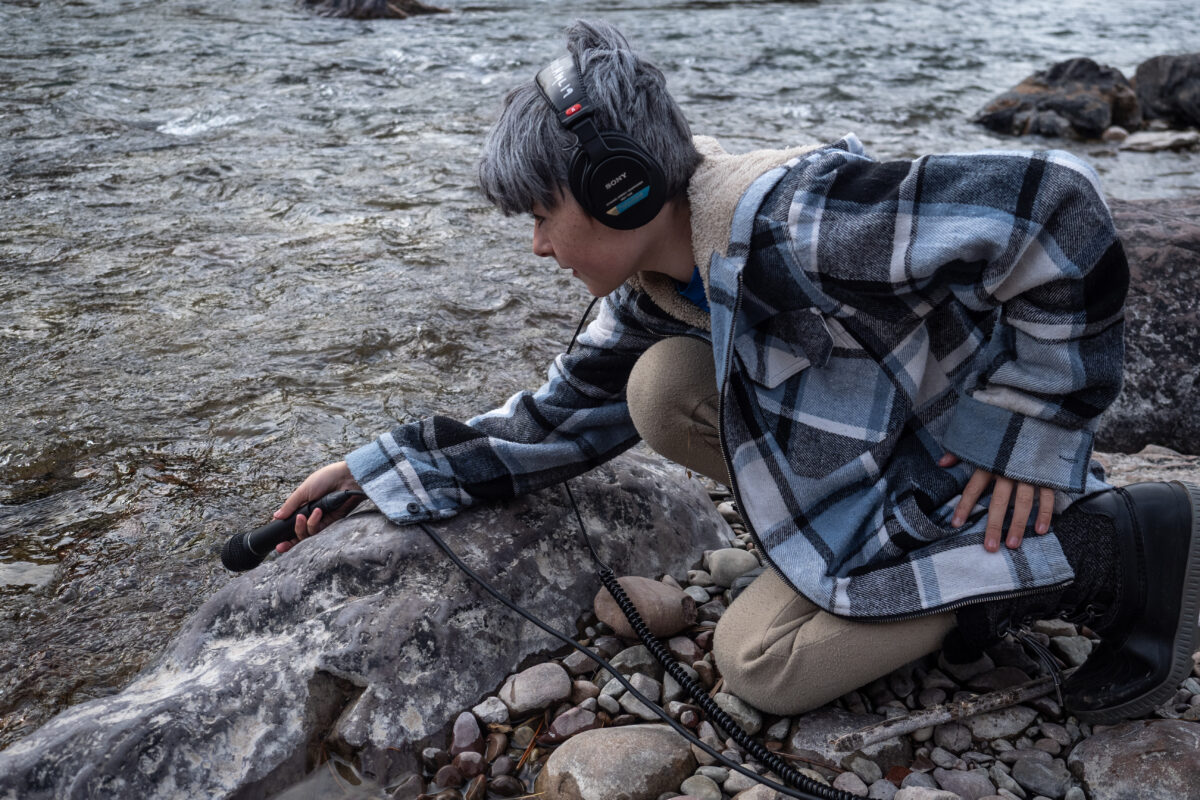
Student reporter Keyvn Masters captures environmental sound of the Blackfoot River underneath the Sunset Hill Road Bridge. Photos by Montana Media Lab Youth Voices Intern Owen Preece and freelance photographer Maddie McCuddy.
The recent closure of a historically significant and functionally important bridge spanning the Blackfoot River left Greenough, Montana residents feeling isolated. Students at Sunset School, a one-room schoolhouse in operation since 1917, worked together to create an audio story about the future of the bridge and what it means to residents of the Blackfoot River valley.
The Sunset Hill Road Bridge is the last of six original metal bridges, providing passage over the Blackfoot River since 1907. In September of 2025, the bridge was fenced off by Missoula County Public Works. The Montana Department of Transportation deemed the bridge could no longer safely carry traffic, including foot traffic. Shortly after, a proposal to replace the bridge, claiming a $4.1 million price tag, proved a setback.
Student reporters Mia Stehlik and Conley Mercer interview county commissioner Juanita Vero about the Sunset Hill Road Bridge.
Six students ranging from 5th grade to 8th grade identified potential sources, wrote interview questions, and recorded narration. They interviewed Greenough community figures as well as their county commissioner and a state bridge inspector. What they discovered is a community connected by a common thread: the Sunset Hill Road Bridge. For some, it provided a serene view on their drive home from a long day of work. For others, the bridge represented the simple beauty of getting to see their neighbors more often. For the students of Greenough, the closure presented a new danger: in the event of a large wildfire on the western side of the school, the bridge would become the only viable escape route.
The future of the bridge remains uncertain after a tax levy that would have partially funded the construction of a new bridge failed to pass in October. Missoula County has applied for two federal grants for the new bridge in recent years, but did not receive them.
County Commissioner Juanita Vero told student reporters on October 31, 2025, “ There’s no way that just us in this room or just us in the county, your parents would be able to pay for this… So yes, we’re waiting for other sources and right now the federal government’s closed down, so that makes it very difficult to even have these conversations or plan or look for those grants. So we’re just gonna have to wait. We’re stuck waiting.”
After a week of reporting, students assembled interview tape, natural sound, and narration into a cohesive audio story and presented their work to members of the community at Sunset School on October 31, 2025.
Photos by Montana Media Lab Youth Voices Program Manager Mike Green.
What does the buffalo mean to the Nakoda and Dakota people of Eastern Montana? That’s the question students in Poplar set out to answer during a hands-on cultural education week. The Montana Media Lab was lucky enough to join them and help the students make an audio story about the experience. Students learned journalism and audio reporting basics, and then dove into interviewing community members about their relationship with the buffalo.
The Montana Media Lab’s Youth Voices Program visited the Fort Peck Reservation during the week of the Buffalo Unity Project. Educators at Poplar Middle School lead the project, intended to connect young people to tribal cultural practices. In reporting on the project, students explored how the Fort Peck community teaches the next generation about their cultural lifeways tied to the buffalo, which once roamed by the millions on their aboriginal lands of the Great Plains.
Poplar Middle School students pose with school faculty and staff after the buffalo hunt.
For Poplar seventh graders, the Buffalo Unity Project’s main event is the buffalo hunt. On the windy October morning of the hunt, 60 students arrived at the tribally-owned buffalo ranch at 9 a.m. sharp. They held microphones and cameras, ready to document their experience and share it. The kids were clad in their bright yellow Buffalo Unity Project shirts, and their anticipation was palpable. As they piled off the bus, excited chatter about the buffalo hunt filled the air.
Herds of buffalo galloped in the distance, while leaders of the Buffalo Unity Project guided the students through teachings about the native mammal and its deep spiritual and cultural significance to the Nakoda and Dakota people. First on the agenda was a pipe ceremony, where each student cleansed themselves in sage and listened intently to the prayers and drum ceremony that is customary for the buffalo hunt. Next, they waited for Reyna Perez, their assistant principal and the chosen person to shoot the buffalo, to return.
Reyna Perez holding the head of the buffalo.
When the truck crested the prairie hill, it was clear that Mrs. Perez had been successful. The students crowded around to fist-bump her and witness the buffalo up close. Students practiced skills they used during the Youth Voices workshop to record that celebration, and the processing of the buffalo. Those recordings will give the listeners of their final audio story a sense of what it was like to witness a buffalo hunt.
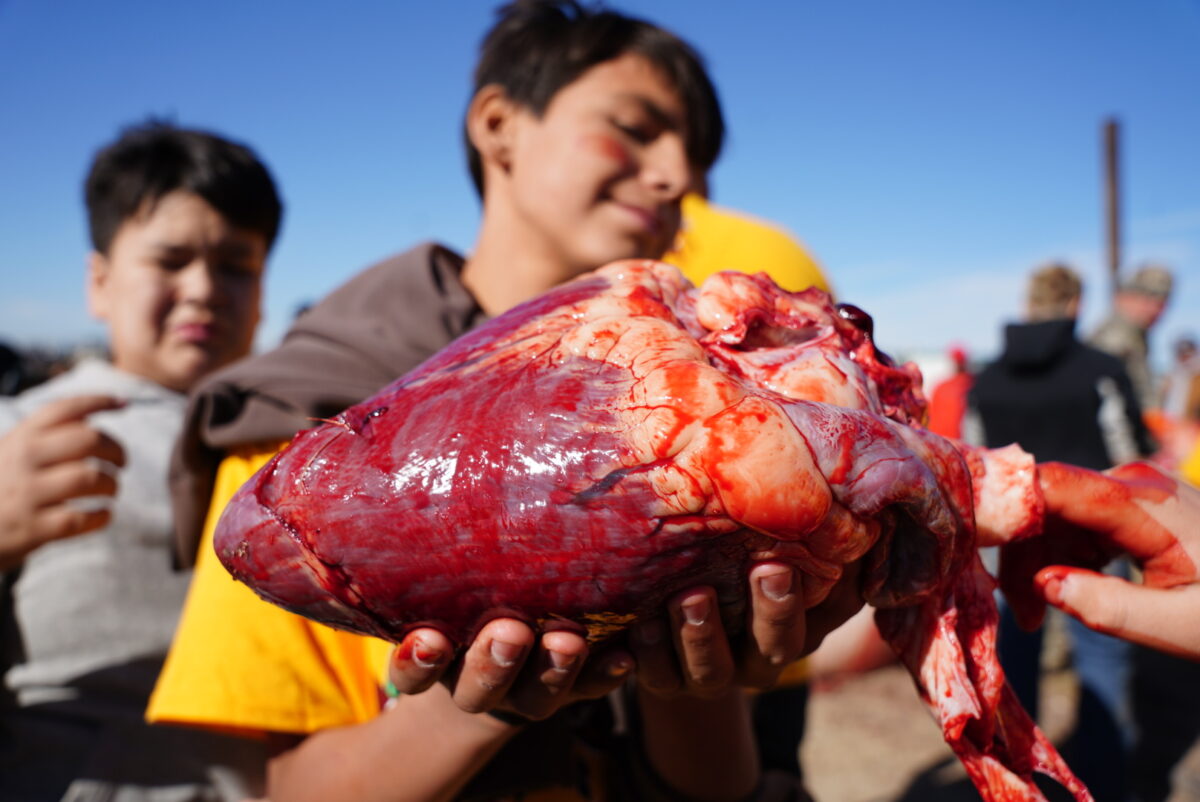
The students watched in rapture as the large bull was taken down and processed by ranch owner Robbie Magnan. Magnan explained the different body parts and their uses for food, clothing, and regalia. No part of the buffalo goes to waste. The buffalo’s liver is believed to signify strength, and Magnan said those who ate it would receive some of that strength. Some students took bites of the organ.
Ranch owner, Robbie Magnan processes the buffalo as students watch and learn.
By the end of the day, the students had gathered all kinds of sounds, interviews, and photos that would help others understand the meaningful experience of witnessing the buffalo hunt—and how the hunt connected them to their heritage. The students’ reporting captured part of the Fort Peck Reservation tribes’ relationships to the land, the buffalo, and one another. Along the way, they contributed to documenting the ongoing story of the Nakoda and Dakota people and sharing it with the world.
After their fellow students expressed concerns for the lack of employment and after-school activity opportunities in Arlee, Montana, young journalists at Arlee High School embarked on a reporting journey to better understand the places and people supporting youth in their town. They honed their interview and recording skills by talking with entrepreneurs, fellow students, high school staff, and community organizers. They took reporting trips around the town and the surrounding area to the Arlee Community Center and Kampfire Steak House, which hires student employees. Along the way, they found a new business, hoping to uplift the people of Arlee, especially its youth.
Photos by Montana Media Lab Intern Owen Preece
Auntie’s Emporium opened in July and is a Native-owned market founded by Jamila James. James told the student reporters, “The way we strengthen a community is by working together and by lifting each other up. We need to have a space for teenagers to get job skills. That’s through working. We need to have a space that is drug and alcohol free. And we need to have a space that focuses on our community and the longevity of that.”
The students learned that Auntie’s Emporium is a restaurant informed by the seasons, but is also starting to foster a community center in the same building, hosting movie nights, native games, and building two recording studios.
At the end of the reporting week, the students dug through and edited together interview clips, recorded narration, and presented the story to Arlee High School students and staff in their school library! Check out photos of the students reporting and listen to their story above.
Written by Youth Voices Program Manager Mike Green
What does the future of energy look like in southeast Montana? That’s the question a group of high school students in Lame Deer set out to answer during a 4-day Youth Voices audio journalism workshop hosted by Chief Dull Knife College and the Montana Media Lab.
Over the course of four days, the students dove into the complex conversation around nuclear energy development in a region historically shaped by coal. With audio recorders in hand, they toured the Westmoreland Rosebud coal mine, interviewed members of their community, and spoke with Montana state representatives about the possibility of transitioning to nuclear power.
Working as a team of young journalists, the group learned the complexities facing the Northern Cheyenne and Colstrip communities. As Montana eyes a potential transition away from coal, not everyone is thrilled to have nuclear developments right next door.
For many, it was their first time working as journalists—and they rose to the challenge. They practiced interview techniques, captured ambient sounds from the field, and learned the basics of audio production. These tools helped them explore not only how energy is produced, but also how to tell a story that can hold nuance, raise questions, and include a range of perspectives.
The workshop also featured a visit from Robyn Iron, a KPAX reporter and recent graduate of the University of Montana School of Journalism. Robyn, who is a member of the Northern Cheyenne, shared her experience working on Highway of Death, a student-produced documentary about traffic fatalities on Highway 212. Her conversation with the students sparked important dialogue about what it means to report from your own community, how to handle difficult interviews, and how journalism can be a tool for both accountability and connection.
By the end of the week, the students had a deeper understanding of energy in Montana and the power of storytelling.
We’re grateful to Chief Dull Knife College for hosting this project and creating space for young people in Montana to engage with real-world issues through hands-on learning. Keep an eye out for the final story, which will be released soon.